
Reading Time: mins

Twisting to reach something in the back seat, or rotating to check a blind spot, and feeling a sharp catch in your lower back is one of the clearest signs of facet joint pain in back. The facet joints are small, paired joints that sit at the back of each vertebra, and they’re built specifically to handle rotation and extension, so when they’re irritated, those are exactly the movements that set them off. Facet joint pain is a distinct cause of back pain, different from a disc problem or sciatica, and it responds to a different kind of treatment. This guide explains what these joints do, what facet joint pain actually feels like, and why confirming it properly, rather than guessing from a scan alone, changes what treatment actually works.
Every vertebra in your spine connects to the one above and below it through two small joints at the back, called facet joints. In the lower back, these are the lumbar facet joints, and there’s a pair at each level running down the spine. Their job is to guide how much your spine can bend, twist, and extend, while keeping the vertebrae from sliding too far out of line.
Because the lumbar vertebrae facet joints carry a large share of the rotational and shear force your lower back absorbs every day, from reaching into a cupboard to turning in a car seat, they’re prone to irritation and, over time, wear. That’s different from the discs, which mainly absorb compression. Facet joints and discs often get blamed for the same symptom, lower back pain, but they’re separate structures with separate reasons for hurting.
If your clinician uses the term facet joint syndrome, lumbar facet joint pain is what they mean. It’s the clinical name for pain coming specifically from these joints, rather than from a disc, a nerve root, or the muscles around the spine. You might also hear it called facet arthropathy, most often used when wear and tear on the joint is the underlying cause. Lumbar spondylosis, which we’ve covered before, can include facet joint changes as one part of wider age-related spinal degeneration. This guide looks at facet joint pain on its own, as its own diagnosis, rather than as one piece of a broader picture.
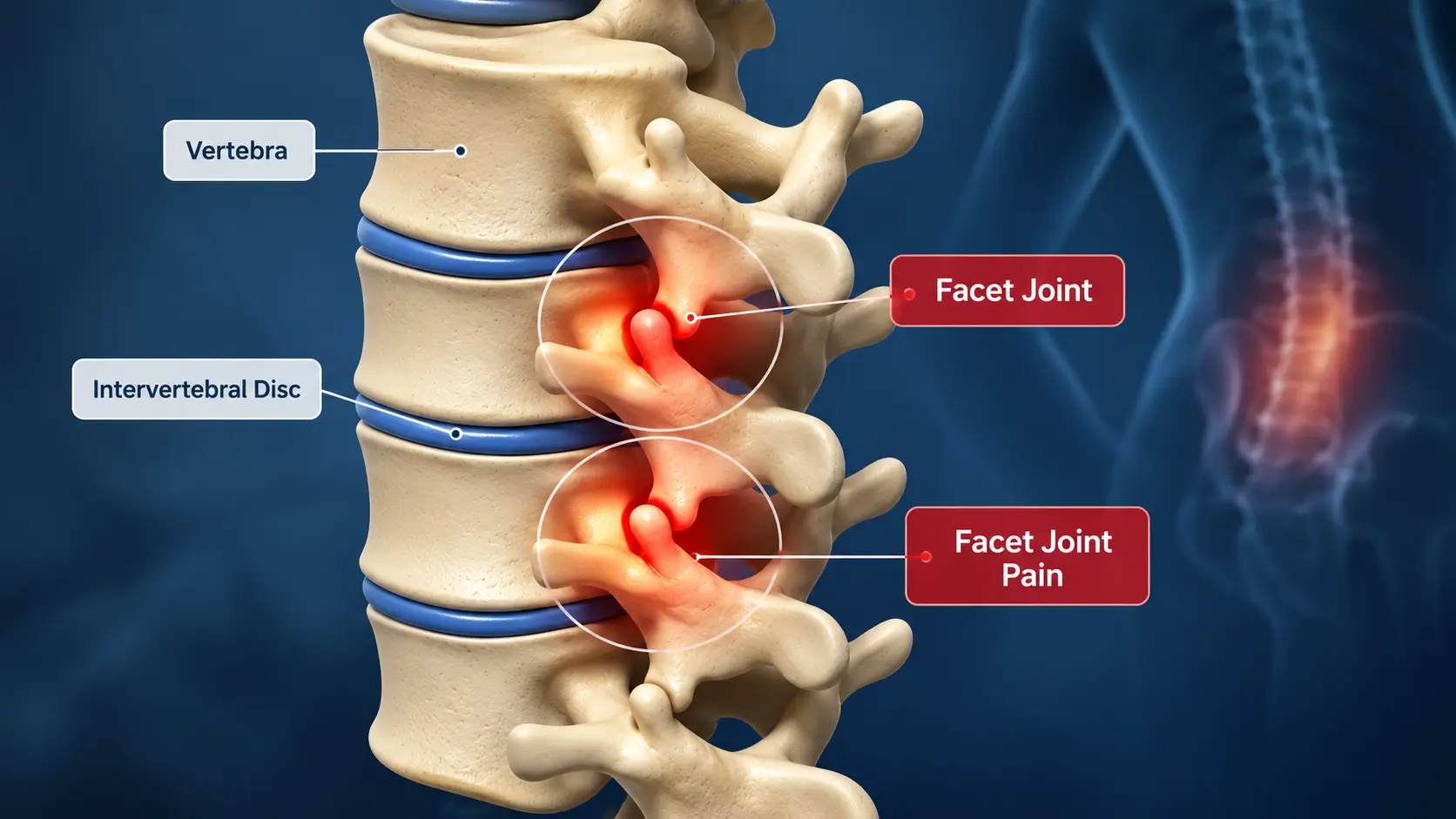
Lumbar facet joints pain tends to have a recognisable pattern, even though it’s often mistaken for general back strain. It’s usually felt as a deep, dull ache across one or both sides of the lower back, and it can radiate down into the buttock, the side of the groin, or the back of the thigh, typically stopping above the knee. That’s a useful clue in itself: pain that travels further down the leg, especially with numbness or tingling, points more toward a nerve problem than a facet joint.
The movements that bring it on are specific too. Extension, which means arching backward, along with rotation and twisting, tend to make it worse, since those are the exact motions the facet joints are built to control. Standing for long periods or sitting for a long stretch can aggravate it as well. Many people notice it’s worse first thing in the morning or after being still for a while, and eases slightly once they start moving, before building again with activity.
Many people first notice it with one specific, repeatable trigger, reaching for a seatbelt, twisting to check a blind spot, or standing up from a low chair, rather than as a constant background ache. The pain can also change with posture, often easier when lying flat and harder when upright and active for a while. That pattern of pain tied closely to particular movements, rather than present all the time regardless of what you’re doing, is itself a useful clue pointing toward the facet joints rather than a more general muscular strain.
Facet joint pain usually comes down to wear, strain, or injury affecting these small joints over time.
Most cases we see combine more than one of these factors, which is part of why the joint can start causing trouble gradually rather than from one clear incident.
A facet joint arthritis xray can show joint space narrowing, bone spurs, or changes in the shape of the joint, which confirms wear is present. What it can’t do is confirm that a particular joint is actually the source of your pain. Plenty of people have facet joint changes on an X-ray or MRI with no pain at all, and plenty of people with real facet-mediated pain have scans that look relatively unremarkable. Imaging is useful for ruling other things out and building a general picture, but on its own it doesn’t tell us where your specific pain is coming from. That distinction matters, because it means a scan alone is never enough reason to jump straight to a procedure.
There’s no single symptom that confirms facet joint pain on its own, but a combination of signs makes it more likely:
If you’ve noticed sore facet joints in back muscles around the spine alongside this pattern, that’s a reasonable prompt to get it properly assessed. The only way to actually confirm the diagnosis is a controlled diagnostic injection, which numbs the small nerve supplying the joint and checks whether that removes your pain, something we cover under treatment below.
Matching this pattern yourself is a reasonable starting point, but it isn’t a diagnosis on its own. Several different structures in the lower back can produce broadly similar symptoms, which is exactly why a proper assessment involves more than a conversation about what the pain feels like. A hands-on examination helps narrow down which structures are most likely involved, before any diagnostic test is used to confirm it.

A few habits make facet joint pain harder to manage, or delay getting an accurate answer.
NHS commissioning guidance for facet joint treatment reflects this same order: conservative care first, a confirmed diagnosis before any procedure, and treatment only once there’s a documented reason to expect it will help. Skipping steps doesn’t speed up recovery, it usually just delays getting the right one.
How long facet joint pain lasts depends heavily on the cause and what’s actually been done about it. A minor strain-type flare, without much underlying arthritis, often settles within a few weeks with activity changes and simple care. Pain linked to ongoing joint wear tends to come and go, flaring with triggers like twisting or prolonged sitting, and settling in between, rather than following a single clean recovery timeline.
For a minor flare, gentle movement generally helps more than complete rest, since the joints stiffen up when they’re kept still for too long. Easing off the specific trigger, whether that’s a twisting sport, long drives, or hours hunched over a desk, while staying generally active, tends to shorten the length of a flare more reliably than waiting it out.
For pain confirmed by a diagnostic block, radiofrequency ablation is one of the main procedures used when symptoms keep recurring. Many patients report real, lasting relief, and on our own figures, that relief typically starts within one to three weeks and can last six to eighteen months before the nerve regrows and the procedure can be repeated if needed. It’s worth being upfront, though: the latest NHS guidance on facet joint pain and recent controlled trials show the evidence for radiofrequency ablation is still developing, with some recent studies finding results closer to a placebo procedure than hoped. That’s exactly why we use the diagnostic block first, to find out who is actually likely to benefit, rather than offering the same procedure to everyone regardless of how they respond.
Treatment here follows a deliberate order rather than a single default step: confirm the diagnosis first, then choose the next step based on what that actually shows.
A medial branch block is a small, image-guided injection of local anaesthetic around the tiny nerve that supplies a specific facet joint. If your pain eases markedly in the hours afterward, that confirms the joint as the source. If it doesn’t, we know to look elsewhere rather than continuing to treat a joint that was never the real problem.
This diagnostic step is also how we decide who is a good candidate for radiofrequency ablation later, drawing on founder Dr Ralph Rogers’s years of image-guided musculoskeletal work to make sure the right structure is being targeted before anything longer-lasting is done. It’s a more precise approach than treating based on symptoms or a scan alone, and it’s the reason we don’t offer injections or ablation as a routine first step for everyone who comes in with back pain.
A facet joint injection places steroid directly into the joint to calm inflammation, and can provide relief for weeks to months, especially when wear and tear is the main driver. It’s often used as a next step after a positive diagnostic block, or sometimes combined with the block itself.
Radiofrequency ablation goes a step further for pain that keeps recurring. It uses heat to disrupt the small nerve that carries pain signals from the joint, rather than treating the joint directly, and it’s typically reserved for patients who’ve already shown a clear, lasting response to a diagnostic medial branch block. As covered above, we’re honest that outcomes vary between patients and the research evidence is still evolving, which is exactly why that diagnostic step matters so much. If the relief afterward doesn’t match what the diagnostic block suggested, that’s useful information in itself, and we use it to reconsider the plan rather than repeating the same procedure regardless.
Both procedures are available through our lower back spinal injections service, performed under image guidance for accuracy. Current pricing for each is on our current fees page.

We are a private regenerative orthopaedics and sports medicine clinic on Blythe Road in London, founded by Dr Ralph Rogers, and every case that comes through our door is one we personally assess and treat. We work with a wide range of insurance providers, as well as self-funding patients, so getting a proper diagnosis doesn’t have to wait.
If twisting or turning keeps setting off your back pain and you’re not sure why, we can find out rather than leaving you guessing between stretches, painkillers, and hoping it settles on its own. You get a specialist assessment without a long NHS-style wait, a genuine diagnosis built on a confirmatory test rather than a best guess from a scan, and a clear next step once we know what we’re actually dealing with. Because we confirm the source before recommending a procedure, you also get confidence that whatever we suggest next has a real reason behind it, not a default response to back pain in general.
Booking is simple: fill out our request an appointment form with a short description of your symptoms, and our team will get back to you to arrange a time.
| Service | Indicative Price |
| Diagnostic medial branch block | From £2,000 |
| Facet joint injection | From £1,800 |
| Radiofrequency ablation (lumbar) | From £1,300 |
Visit our current fees page for exact, up-to-date pricing, since costs can vary by hospital location.
We also treat a wide range of other conditions through our non-surgical treatments programme at RRMG. If you’d like to know more before booking, you can read about our clinic and Dr Ralph Rogers’s background.
Get in touch
Yes, this is actually typical. Facet joint pain linked to ongoing wear often flares with specific triggers, such as twisting, prolonged sitting, or a long day on your feet, then eases once you rest or change position. That on-and-off rhythm is different from how a disc problem usually behaves, and it’s one of the details we ask about directly during an assessment, since the pattern itself helps point toward the facet joints as the source. If flares are becoming more frequent, more intense, or lasting longer each time, that shift is a reason to book a fresh assessment rather than assume it’s settling the same way it always has.
Facet joint pain ranges from a mild, nagging ache to pain severe enough to limit how far you can twist or bend. Most cases are uncomfortable rather than dangerous, and respond well to the right combination of activity changes and, where needed, a diagnostic block and targeted treatment. It becomes more concerning if pain starts radiating down the leg with numbness or weakness, since that points toward a different cause needing more urgent assessment.
Most people describe it as a deep, dull ache across one or both sides of the lower back, sometimes spreading into the buttock or the back of the thigh. It’s usually worse with twisting, arching backward, or standing for a long time, and often stiffer first thing in the morning. Unlike nerve-related pain, it doesn’t typically produce sharp, shooting sensations down the leg or numbness in the foot.
It can, but usually only as far as the back of the thigh, stopping above the knee. Pain that travels further down the leg, especially past the knee or into the foot, or comes with numbness or tingling, is more likely to be a nerve problem such as sciatica rather than facet joint pain on its own. That distinction matters, because the two causes are assessed and treated differently.
Dr Rogers has had a rich and illustrious career so far, which is continuing to grow and develop. Everything Ralph has been involved in since qualifying has added value to his knowledge and experience, but there have been some impressive highlights to note:
2018 – Present Founder Medical Director: Rogers Regenerative Medical Group (RRMG)
2012 – 2024 Medical Advisor – National Basketball Association
2008 – 2018 Medical Director: The London Sports Injury Clinic London
2010-2011 First Team Doctor, Chelsea Football Club
2007- 2010 The Football Association (Team Physician for England under 19 and development squads)
2005-2006 Medical Advisor: Trinidad & Tobago World Cup Football Team
2002 – 2008 Club Doctor: Walsall Football Club, West Midlands England
1998 – 2009 Medical Director: Medical & Orthopaedic Sports Therapy,
2000 – 2005 Sports Physician: Warwickshire County Cricket Club, Birmingham