
Reading Time: mins
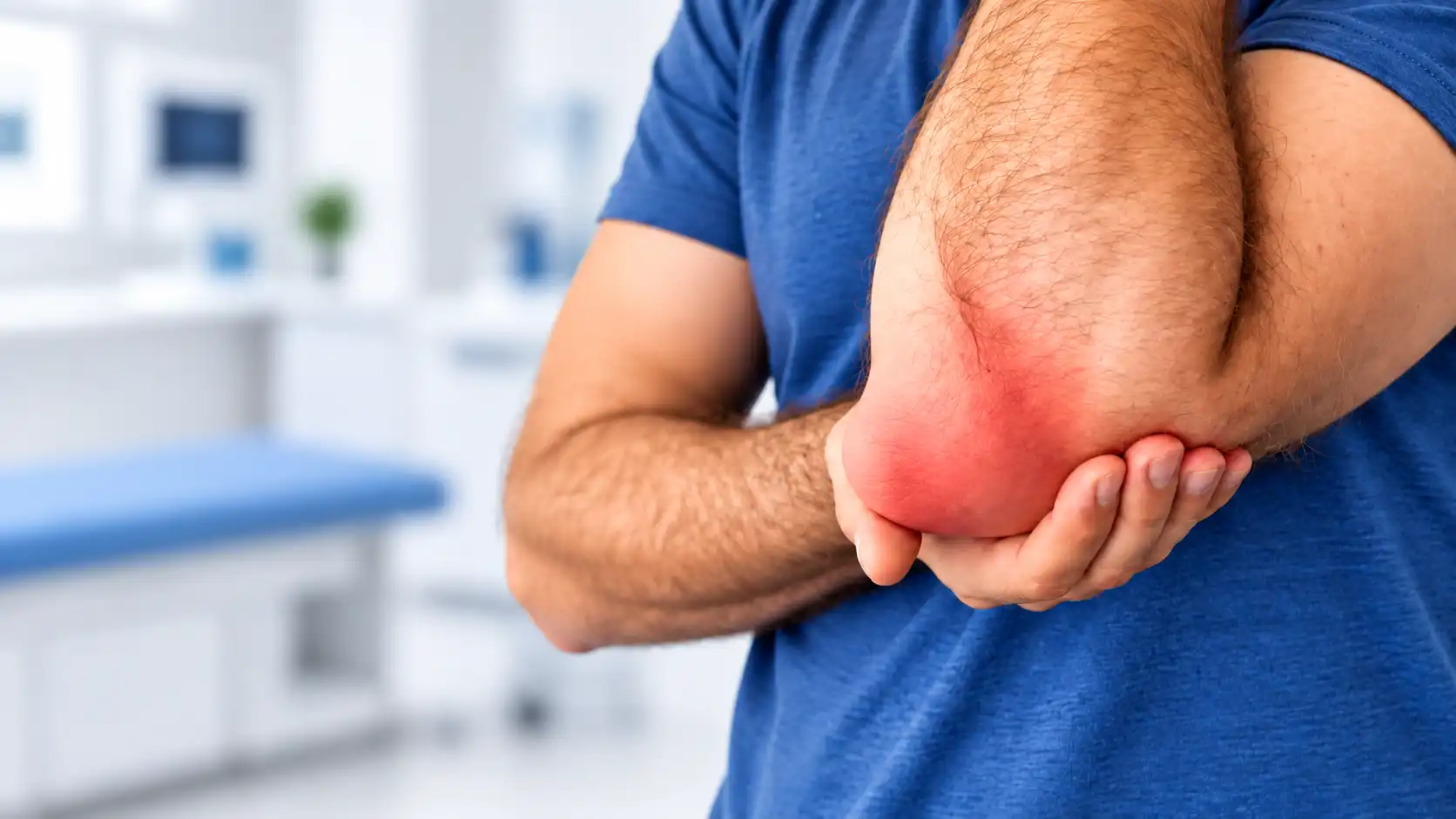
Most elbow bursitis is not an emergency. Swelling that builds up over the tip of the elbow, sometimes called the olecranon bursa, is usually caused by leaning on hard surfaces or knocking the elbow, and it settles down with basic care. But a smaller number of cases are a different problem entirely: the bursa becomes infected, and treating an infected bursa the same way as an ordinary swollen one can let things get worse. At RRMG, we see both kinds regularly, and the two need different responses. This guide walks through what causes elbow bursitis, what the swelling usually looks like, and the specific signs that separate an infected bursa from a mechanical one, so you know when rest and ice are enough and when you need to be seen.
The olecranon bursa is a small, fluid-filled cushion that sits just under the skin at the tip of the elbow. Its job is to reduce friction between the skin and the bone underneath it when you lean on a hard surface. When that bursa is irritated, it fills with extra fluid and pushes up as a soft, sometimes squishy lump, which is what people usually mean by elbow bursitis. It is sometimes nicknamed student’s elbow, after the effect of resting on a desk for long stretches at a time.
There are a few distinct reasons this happens, and they are not all the same problem wearing different clothes:
The first two causes make up most cases we see. The last one is the reason this guide exists, because an infected bursa needs a different plan to one that has simply filled up with fluid.
Gout does not only affect the big toe. When urate crystals settle in the tissue around the elbow, the olecranon bursa can become inflamed in much the same way a joint does during a flare, producing swelling that looks a lot like ordinary bursitis from the outside. The giveaway is usually the pattern: gout-related swelling tends to come on quickly, is often intensely painful even at rest, and may follow a known trigger like alcohol, certain foods, or dehydration. Rheumatoid arthritis can cause a similar picture over a longer timeframe. Neither of these is something we can diagnose from a description alone. If you already know you have gout or rheumatoid arthritis and your elbow swells up in a familiar way, it is still worth having it checked, since an inflamed bursa from either condition can go on to pick up a secondary infection.
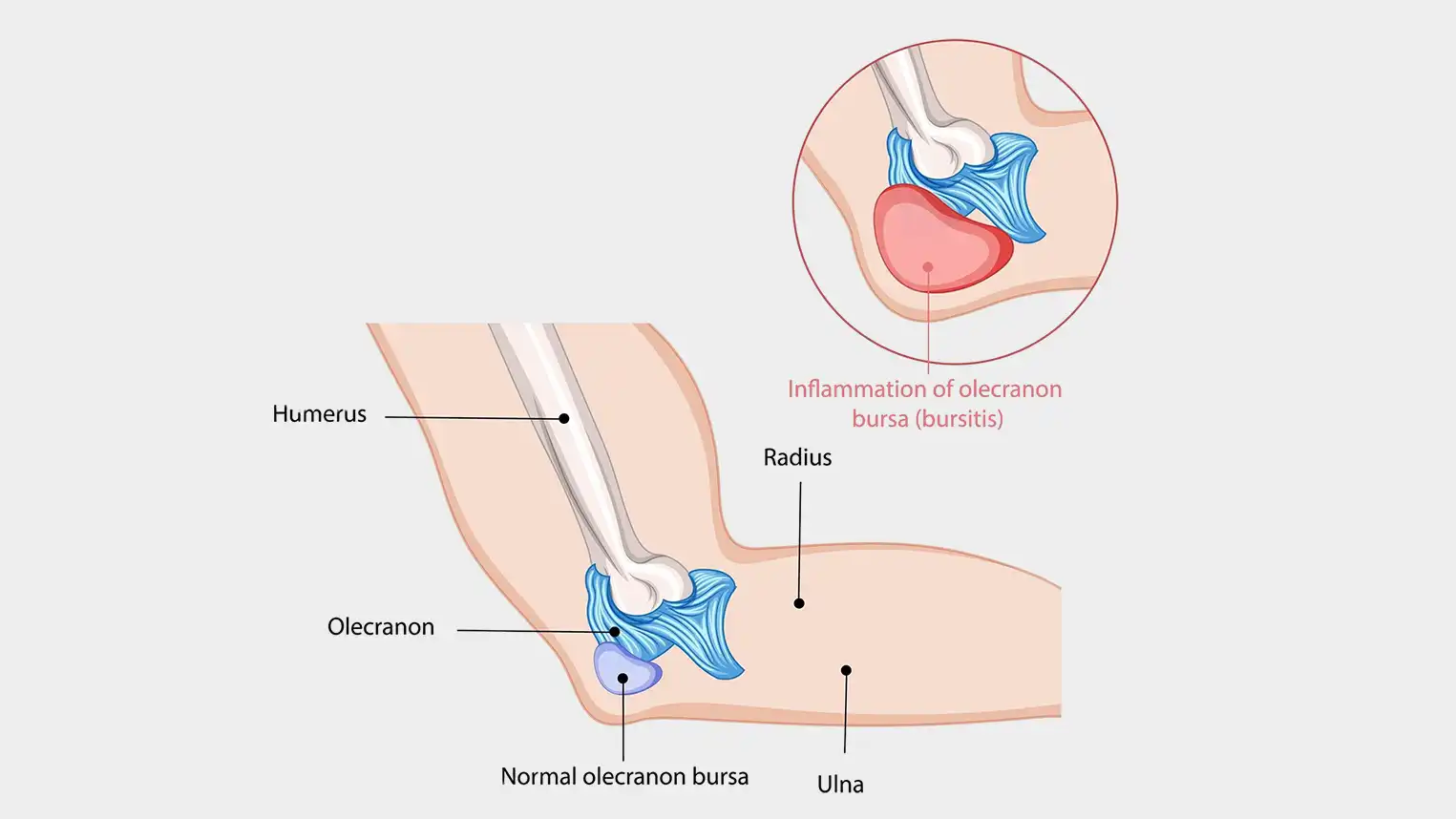
Not every case of elbow bursitis hurts in the same way. A bursa that has simply filled with fluid from pressure is often more uncomfortable than painful, especially at rest, and the discomfort tends to ease once you stop leaning on it. Pain that is sharp, constant, or getting worse by the day is a different pattern, and it points toward either an infection or a more inflammatory cause like gout.
Movement is a useful clue too. With ordinary mechanical bursitis, you can usually still bend and straighten your elbow close to normally, even if the swelling looks alarming. If bending the joint is noticeably restricted, or the pain stops you using your arm for ordinary tasks, that is a stronger signal to get it looked at rather than waiting it out.
Bruising around a swollen elbow is common after a direct knock or fall, and on its own it is not a red flag. Blood under the skin from the original injury can spread and change colour over several days, which sometimes makes the area look worse before it looks better. What matters more is what is happening alongside the bruising. Bruising plus rapidly spreading redness, plus a fever, is a different picture entirely, and points toward infection rather than an ordinary bump. If the bruising followed a clear injury and the swelling is gradually improving, that is reassuring. If it followed no obvious injury, or it is spreading rather than fading, get it assessed.
This is the question this guide is really here to answer. Infected bursitis, known clinically as septic bursitis, needs prompt treatment with antibiotics and sometimes drainage. Mechanical bursitis usually just needs time and simple care. Here is how the two actually differ in practice.
Doctors distinguish septic bursitis from ordinary bursitis by looking at a cluster of signs together, not any single one in isolation. In septic cases, marked tenderness is present in the large majority of patients, along with visible redness or spreading skin infection in most cases, noticeable warmth over the swelling, and, in around a third to two in five patients, a fever. Marked tenderness in this context usually means the area is painful even to a light touch, not just when you press on it directly. Mechanical bursitis, by comparison, tends to look far less inflamed. The skin over the swelling is usually a normal colour or only mildly pink, it is not hot to touch, and there is no fever.
The NHS guidance on bursitis advises seeing a doctor promptly if a swollen joint comes with a high temperature, since that combination points toward infection. We would add one more practical marker: if the skin over the bursa is spreading, getting wider or more red day by day, treat that as urgent too, even without a fever yet.
Septic elbow bursitis and mechanical elbow bursitis can look surprisingly similar in the first day or two, which is exactly why relying on appearance alone is risky. Around two-thirds of elbow bursitis cases turn out to be mechanical rather than infected, so infection is the less common outcome, but it is also the one that gets worse quickly if it is missed. A bacterial infection, most often introduced through a break in the skin near the bursa, can spread beyond the bursa itself if it goes untreated.
The only reliable way to tell the two apart is a proper assessment, sometimes alongside sending a small sample of the fluid for testing. That sample can be checked under a microscope for white blood cells, cultured to look for bacteria, and examined for the crystals that point to gout rather than infection. That is a deliberately different approach from guessing based on how the swelling looks, and it is the reason we always assess before treating rather than treating first and seeing what happens.
No. If you are tempted to pop or drain a swollen elbow bursa yourself with a needle at home, please don’t. It might seem like a quick fix for an uncomfortable lump, but it carries two real risks that are easy to underestimate.
First, a needle that isn’t sterile, guided, or placed correctly can introduce bacteria straight into a bursa that wasn’t infected to begin with, turning a simple mechanical swelling into a genuine infection. Second, draining the fluid does nothing about whatever is still causing the bursa to refill, so the swelling typically comes back within days, often larger than before.
When we assess an elbow bursa at RRMG, we use ultrasound to see exactly where the fluid sits and how much is there before touching it with a needle, drawing on founder Dr Ralph Rogers’s years of image-guided musculoskeletal work. That same imaging tells us, alongside how the swelling looks and feels, whether we are dealing with an ordinary mechanical bursa or something that needs a different plan. Guesswork is exactly what this approach is built to remove.
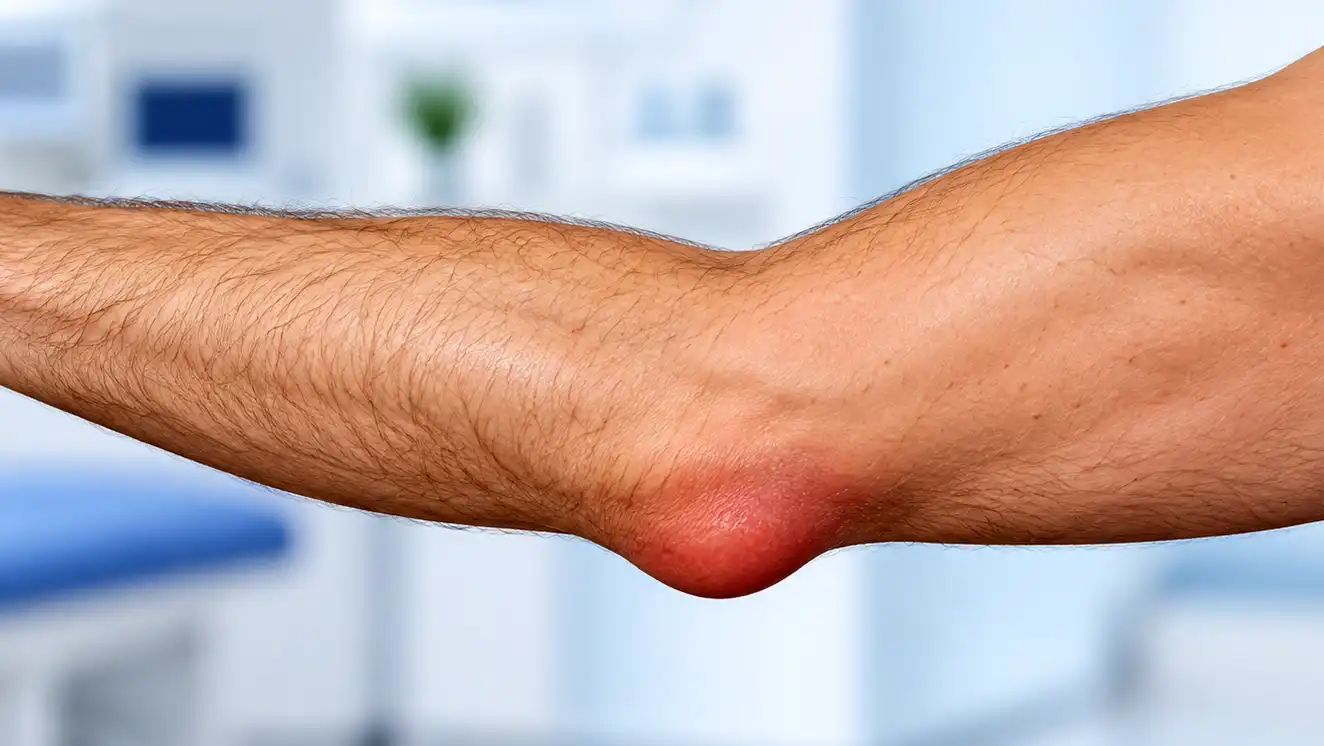
Treatment depends entirely on what is actually causing the swelling, which is why the assessment above matters so much. Broadly, it comes down to two procedures, used differently depending on the cause.
Ultrasound-guided aspiration removes the built-up fluid directly from the bursa, which relieves the pressure and swelling straight away, and lets us send a sample for testing when infection is a possibility. This is often the first step, both because it treats the immediate symptom and because it gives us real diagnostic information rather than a guess. Most people notice the swelling flatten within a day, though how quickly it stays down depends on what caused it in the first place.
Steroid injection is sometimes used afterward to calm ongoing inflammation, but we are upfront with patients that this is not automatically the right next step for every elbow bursa. The skin over the olecranon is thinner than over most other joints, and steroid injected into that area carries a higher chance of side effects like skin thinning or a small sinus forming at the injection site, compared with steroid injections elsewhere in the body. For that reason, we use it selectively rather than as a routine add-on, and we explain the trade-off before recommending it. If there is any suggestion of infection, steroid is avoided altogether until that possibility has been ruled out.
Both procedures are performed under ultrasound guidance, which lets us see the bursa and the surrounding tissue clearly rather than working from feel alone. You can read more about our non-surgical treatments, including where these procedures typically sit in cost, on our current fees page.
Elbow bursitis recovery time varies with the cause. Mechanical bursitis that is managed properly, whether that means rest and activity changes or aspiration for a very full bursa, typically settles within about four weeks for most people. Some cases resolve faster, especially smaller amounts of swelling caught early.
Septic bursitis takes longer and needs antibiotics as the primary treatment, with drainage used to confirm the diagnosis and relieve pressure rather than as the whole treatment on its own. Recovery here is measured more by how the infection responds to antibiotics than by the swelling alone, and it is not something to manage without medical input.
Gout-related and rheumatoid-related bursitis tend to improve as the underlying flare is brought under control, which is a slightly different timeline again. If your swelling keeps coming back after apparently clearing up, mention that recurrence pattern to whoever is treating you, since it can change what the next step should be.
Recurrence is common when the original trigger is never addressed. A bursa drained once but still leaned on every day at a desk or workbench will usually refill, which is why we talk through activity changes or simple padding alongside any procedure, not just the procedure on its own. A single injection rarely solves a problem that a daily habit keeps causing.
General elbow bursitis care at home, such as rest, ice for short periods, and avoiding further pressure on the point of the elbow, can make sense while you decide whether you need to be seen, but it is not a substitute for finding out whether the swelling is infected. Treat home care as something you do alongside getting checked, not instead of it.
Get seen promptly if you notice any of the following:
None of these on their own means something is seriously wrong, but any one of them is a fair reason to get an assessment rather than waiting to see what happens next.

We are a private regenerative orthopaedics and sports medicine clinic on Blythe Road in London, founded by Dr Ralph Rogers, and every case that comes through our door is one we personally assess and treat. We work with a wide range of insurance providers, as well as self-funding patients, so cost should not be the reason you put off getting a swollen elbow looked at.
If you are dealing with elbow swelling and you are not sure whether it is mechanical or something that needs urgent attention, we can tell you quickly rather than leaving you to guess. You get a specialist assessment without the long wait that can come with a GP referral, a clear answer about what is actually going on inside the joint, and honest reassurance either way. Once we know exactly what we are dealing with, you also get confidence in the treatment options in front of you, rather than a one-size-fits-all plan. There is no reason to keep living with uncertainty about a swollen elbow when the answer is usually a short appointment away.
Booking is simple: fill out our request an appointment form with a short description of your symptoms, and our team will get back to you to arrange a time.
| Service | Indicative Price |
| Initial consultation | From £300 |
| Ultrasound-guided joint aspiration | From £650 |
| Image-guided steroid injection | From £600 |
Visit our current fees page for exact, up-to-date pricing, since costs can change.
We also treat a wide range of other conditions at RRMG, and if you would like to know more before booking, you can read more about our clinic and Dr Ralph Rogers’s background.
Get in touch
Mechanical elbow bursitis caused by pressure or a minor knock often does settle on its own within one to two weeks with rest, ice, and avoiding further pressure on the elbow. It is less likely to resolve alone if it is caused by infection, gout, or rheumatoid arthritis, all of which usually need specific treatment rather than time alone. If swelling hasn’t budged after two weeks of sensible self-care, that is a reasonable point to get it checked, and it’s a stronger reason to get it looked at sooner if it keeps coming back after settling once already.
Most elbow bursitis is not serious and responds well to simple care or a short in-clinic procedure. It becomes a more serious issue specifically when it is infected, since untreated septic bursitis can spread beyond the bursa itself and needs antibiotics quickly. The seriousness comes down to the cause, not how big the swelling looks, which is why a small but red, hot, feverish bursa deserves more urgency than a large but cool, pale one.
Infected, or septic, elbow bursitis usually looks more inflamed than mechanical swelling: the skin is often noticeably red, warm to the touch, and tender, sometimes alongside a fever. Redness that is spreading rather than staying in one place is one of the clearer signs something needs urgent attention, and it is worth getting checked the same day rather than waiting. A break in the skin nearby, however small, is another detail to mention when you’re seen, since it is often how the infection got in.
Most people with mechanical elbow bursitis can still bend and straighten the elbow close to normally, even though the swelling looks considerable. If movement is noticeably restricted, or using your arm for ordinary tasks is painful, that points toward a more serious cause and is a fair reason to have it assessed rather than pushed through. Pain that increases sharply when you try to bend the elbow fully, rather than staying steady, is a particular sign to mention.
Not always. Many cases of mechanical bursitis settle with rest and activity changes alone. Aspiration becomes useful when the swelling is large, uncomfortable, or when there is any possibility of infection, since draining the fluid also lets it be checked. It should always be done by a clinician under proper guidance, never attempted at home, since the fluid itself carries information a home drain would simply throw away.
Dr Rogers has had a rich and illustrious career so far, which is continuing to grow and develop. Everything Ralph has been involved in since qualifying has added value to his knowledge and experience, but there have been some impressive highlights to note:
2018 – Present Founder Medical Director: Rogers Regenerative Medical Group (RRMG)
2012 – 2024 Medical Advisor – National Basketball Association
2008 – 2018 Medical Director: The London Sports Injury Clinic London
2010-2011 First Team Doctor, Chelsea Football Club
2007- 2010 The Football Association (Team Physician for England under 19 and development squads)
2005-2006 Medical Advisor: Trinidad & Tobago World Cup Football Team
2002 – 2008 Club Doctor: Walsall Football Club, West Midlands England
1998 – 2009 Medical Director: Medical & Orthopaedic Sports Therapy,
2000 – 2005 Sports Physician: Warwickshire County Cricket Club, Birmingham