
Reading Time: mins

Lower back tightness is one of those complaints almost everyone recognises, and almost everyone tries to explain away. You blame a long day at your desk, a hard training session, or simply waking up on the wrong side of the bed, and reach for a stretch or a hot water bottle before giving it much more thought. Most of the time, that instinct is right. But when tightness keeps returning, spreads to your hip, or starts showing up alongside sharper pain, it stops being a stretch-it-off problem and becomes a question that deserves a proper answer.
At RRMG, we see this exact pattern often among the many conditions we treat: patients who have done everything the internet told them to do, and still can’t shake the tightness. This guide walks through what’s behind lower back tightness, when it’s nothing to worry about, and when it’s time to arrange a proper assessment.
Lower back tightness describes a sustained feeling of tension, restriction, or reduced flexibility across the muscles running along your spine, rather than a sharp or sudden pain. It’s often described as a band of pressure, a feeling of being unable to fully straighten up, or muscles that simply won’t release even after rest.
Tightness sits on a spectrum. For some people, it’s a mild, background stiffness that eases within the hour. For others, it can leave the lower back very tight almost constantly, to the point where getting out of a chair or bending to tie a shoe becomes noticeably uncomfortable. Neither end of that spectrum is unusual on its own, but persistent, severe tightness is more likely to have an underlying driver worth identifying.
It’s also useful to separate “tight” from “sore.” When your lower back is tight and sore together, that combination often points to real muscle overload, the kind you’d expect after an unfamiliar workout or a long day of physical work, rather than tightness alone, which can come from posture, stress, or an underlying joint issue without necessarily involving muscle damage. The distinction matters because the two respond differently: soreness after exertion typically settles with rest over a few days, while tightness without a clear trigger can persist for weeks if the underlying cause isn’t addressed.
Clinically, what many patients describe as lower back tightness overlaps with what we call axial pain, pain and tension centred in the spine itself rather than radiating down the leg. If that description sounds familiar, it’s a useful term to know before your next conversation with a clinician.
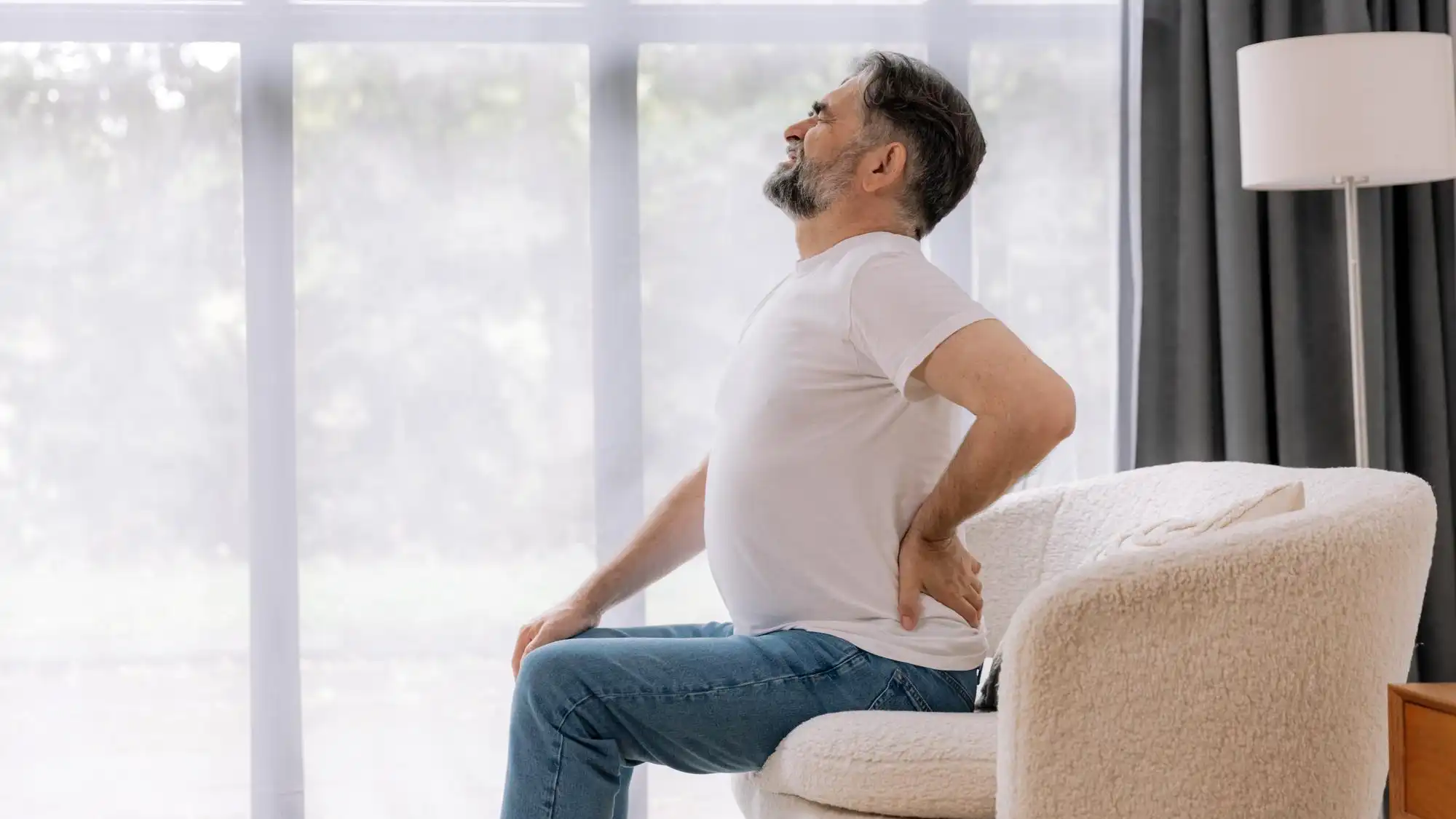
It’s easy to use “tightness” and “spasm” interchangeably, but they describe two different things, and knowing which one you’re dealing with changes what actually helps.
A muscle spasm is an involuntary contraction: the muscle tightens suddenly and doesn’t relax under your control, sometimes described as feeling like a knot forming under the skin. Spasms can be sharp and quite painful, and according to the US National Institutes of Health, common triggers include muscle overuse or injury, dehydration during exercise, low potassium or calcium levels, nerve irritation such as from a herniated disc, and certain repetitive activities like running, swimming, or jumping. Spasms can also strike at night during sleep, and stress is a recognised trigger too, particularly for muscles around the neck and back.
Tightness, by contrast, is usually a sustained state of tension rather than a sudden, involuntary event. It builds gradually, often from posture, prolonged inactivity, or muscles working harder than usual to stabilise the spine, and it tends to ease and return rather than lock up suddenly.
The encouraging news is that most ordinary muscle spasms improve with rest and time, and the same is broadly true for uncomplicated tightness that has an obvious trigger, like a long drive or an unusually intense gym session. Where it pays to look closer is when spasms or tightness become frequent, severe, or start interfering with sleep and daily movement. At that point, the muscle is often compensating for something else, a joint that isn’t moving properly, a nerve that’s irritated, or a postural pattern that’s become entrenched, and treating the muscle alone tends to bring the tightness straight back.
Lower back tightness rarely has a single cause. More often, it’s the combination of how you move, how you sit, and how your muscles are working to protect your spine that adds up to that familiar band of tension. Here are the patterns we see most often in clinic.
Hip and lower back tightness tend to travel together, and there’s a simple reason why. The muscles that flex your hip, especially the hip flexors at the front of the pelvis, attach close to the lower spine. When those muscles are chronically short or overworked, from long periods of sitting or from training patterns that emphasise hip flexion without balancing mobility work, they can pull on the pelvis and alter how your lower back muscles have to work to keep you upright.
This is why stretching your hamstrings alone often doesn’t fully resolve lower back tightness, while addressing hip mobility tends to make a bigger difference for a lot of people. If your tightness consistently shows up alongside hip stiffness, especially after sitting or after activities that involve repetitive hip flexion like cycling or running, that combination is useful to flag specifically when you’re assessed, since it points toward a movement pattern that self-care alone may not fully address.
Exercise-related tightness is common, and the pattern often depends on what you’re doing. Lower back tightness while running is frequently linked to core and hip stability: if the muscles supporting your pelvis fatigue before the rest of your body does, your lower back muscles pick up the slack, tightening to compensate for movement that should be coming from your hips and core. This is especially common on longer runs, on hard surfaces, or when running form breaks down as fatigue sets in.
Lower back tightness after deadlifts, or after other heavy lifting, is usually a different story. Here, tightness is often a normal, protective response (your spinal muscles bracing hard to stabilise your spine under load), and some post-training tightness is expected, particularly if you’ve increased weight or volume recently. That said, tightness that’s disproportionate to the session, that doesn’t ease within a day or two, or that comes with pain radiating elsewhere deserves a proper look at your lifting technique and, potentially, a clinical assessment rather than just more stretching.
In both cases, the underlying theme is the same: your lower back is compensating for something else in the kinetic chain. Addressing that root cause, rather than just the tight muscle itself, tends to be what resolves the pattern long term.
Sitting for long stretches is one of the most consistent triggers we hear about. Part of the explanation is mechanical: research from Harvard Health notes that pressure on your spinal discs is measurably higher when you’re sitting than when you’re standing, and that muscle spasm is the most common source of pain specifically triggered by sitting. Combine that increased disc pressure with hip flexors that shorten over hours in a chair, and your lower back muscles end up working overtime to hold your posture.
This is also a big part of why some people wake up to a lower back stiff every morning, especially after a day spent mostly seated the day before, or after a long evening on the sofa. The muscles have had extended time in one shortened position, and it takes a few minutes of movement for them to release again.
The fix isn’t sitting differently, it’s sitting less. Regular movement breaks, even short ones, matter more than finding the “perfect” ergonomic chair. Standing, walking for a few minutes every hour, and building general movement back into your day tend to outperform passive fixes for this particular cause of tightness.
Waking up with a tight lower back is common enough that it’s easy to dismiss as normal. Most of the time, it is: hours of stillness overnight naturally reduce circulation and fluid movement around your spinal joints and muscles, and that eases within twenty to thirty minutes of moving around.
But if you’re asking why is my lower back tight when I wake up, regardless of how you slept or what mattress you’re using, and it takes longer than that to settle, or doesn’t fully ease at all, that pattern deserves a closer look. We’ve written previously about morning back stiffness linked specifically to facet joint wear, which behaves differently to simple overnight stiffness and tends to respond better to targeted treatment than to more stretching. If mornings are consistently the worst part of your day, it’s a good companion read alongside this guide.
Tightness on its own is usually a muscular, mechanical issue. Lower back tightness and pain together, especially when the pain is sharp, radiating, or getting worse rather than better, is a different signal, and it’s the point where we’d generally recommend moving from self-care to a proper assessment.
Most of the time, added pain still has a simple mechanical explanation: a facet joint that’s become irritated, a muscle that’s been overloaded, or a disc that’s under more strain than usual. But according to NHS guidance on back pain, a small number of symptoms alongside back pain or tightness need urgent medical attention rather than a wait-and-see approach:
These are uncommon, but they’re important to rule out quickly. Outside of those specific signs, pain that persists for more than a few weeks despite rest, gentle movement, and over-the-counter pain relief, or that comes with unexplained weight loss, is also a reasonable trigger to book an assessment rather than continuing to self-manage.
For simple, non-worrying tightness, the NHS’s general advice for back pain holds up well: staying active tends to help more than resting in bed, even though that can feel counterintuitive when your back feels tight and uncomfortable.
A few practical steps tend to make a real difference:
Give these changes a full two to three weeks before judging whether they’re working. Most simple, mechanical tightness responds well within that window. If you’re doing all of this consistently and the tightness either isn’t budging or keeps coming back once you stop, that’s a useful signal in itself, and that’s exactly the point where a proper assessment makes sense rather than continuing to manage it alone.

If self-care hasn’t shifted things after a few weeks, if tightness keeps returning despite doing everything right, or if it’s accompanied by any of the red-flag symptoms above, it’s worth booking a proper assessment with a back pain specialist rather than continuing to guess at the cause.
We start every assessment by working out exactly which structure is driving your tightness, whether that’s a facet joint, an overworked muscle group, a disc under strain, or a postural pattern that’s become entrenched, rather than treating “tight lower back” as a single, generic diagnosis. Getting that right matters, because the treatment that helps one cause of tightness can do very little for another.
Once we know what we’re dealing with, we offer a range of non-surgical treatments depending on the finding:
We deliver every treatment plan personally, using image-guided technique built on more than two decades of experience across professional sport, drawn from founder Dr Ralph Rogers’s years as an NBA medical advisor and a former Chelsea FC first-team doctor. That background means the same precision used to get elite athletes back to competition is applied to every patient who walks through our door, not just professional ones.
It usually means the muscles supporting your spine are holding more tension than normal, often from posture, prolonged sitting, overuse, or a joint that isn’t moving as freely as it should. On its own, tightness is rarely a sign of anything serious, though persistent or worsening tightness deserves an assessment.
Rarely. Most lower back tightness is mechanical or muscular. It becomes more concerning when it’s accompanied by pain spreading down both legs, numbness, bladder or bowel changes, or unexplained weight loss, in which case prompt assessment is important.
Often, yes, especially for tightness linked to sitting, exercise, or general muscle tension. Stretching is less effective when tightness is driven by an underlying joint issue like facet joint irritation, which tends to respond better to targeted treatment than to stretching alone.
If tightness persists beyond two to three weeks of consistent self-care, keeps returning, or comes with pain, numbness, or any of the red-flag symptoms covered above, it’s a reasonable point to book an assessment rather than continuing to manage it alone.
We’re RRMG, a private regenerative orthopaedics and sports medicine clinic on Blythe Road in West London, founded by Dr Ralph Rogers. We personally run every case that comes through our door, and we work with a wide range of insurance providers, as well as self-funding patients.
Lower back tightness is common, and most of the time, it responds well to movement, time, and a bit of patience. But tightness that keeps coming back, spreads to your hip, or shows up alongside real pain is your body telling you something more specific is going on, and that deserves attention rather than being worked around indefinitely.
You won’t be waiting months for an NHS-style referral to find out what’s happening. We can get you a specialist assessment quickly, give you a clear diagnosis instead of another round of guesswork, and talk you through your treatment options with confidence once we know what we’re dealing with. Booking is simple: request an appointment through our contact form, and we’ll take it from there.
For a general sense of cost, here’s what current image-guided treatment options for lower back tightness typically start from:
| Service | Indicative Price |
| Image-guided injection (unilateral) | from £600 |
| PRP injection (single) | from £1,020 |
Visit our fees page for current, exact pricing once your treatment plan is confirmed.
Dr Rogers has had a rich and illustrious career so far, which is continuing to grow and develop. Everything Ralph has been involved in since qualifying has added value to his knowledge and experience, but there have been some impressive highlights to note:
2018 – Present Founder Medical Director: Rogers Regenerative Medical Group (RRMG)
2012 – 2024 Medical Advisor – National Basketball Association
2008 – 2018 Medical Director: The London Sports Injury Clinic London
2010-2011 First Team Doctor, Chelsea Football Club
2007- 2010 The Football Association (Team Physician for England under 19 and development squads)
2005-2006 Medical Advisor: Trinidad & Tobago World Cup Football Team
2002 – 2008 Club Doctor: Walsall Football Club, West Midlands England
1998 – 2009 Medical Director: Medical & Orthopaedic Sports Therapy,
2000 – 2005 Sports Physician: Warwickshire County Cricket Club, Birmingham