
Reading Time: mins

Not every twinge in your lower back needs an appointment, but not every ache resolves on its own either. When facet joint irritation keeps nagging at you, whether it is a dull ache after a long drive or a sharp catch when you twist, the real question becomes whether it is something your body will settle on its own or something that deserves a proper look. Searching your symptoms online only gets you so far, since several different structures in your lower back can produce a very similar feeling. This guide walks through what facet joint irritation actually is, the signs to watch for, and exactly what happens when you book an assessment with us at RRMG, so you know what to expect before you ever pick up the phone.
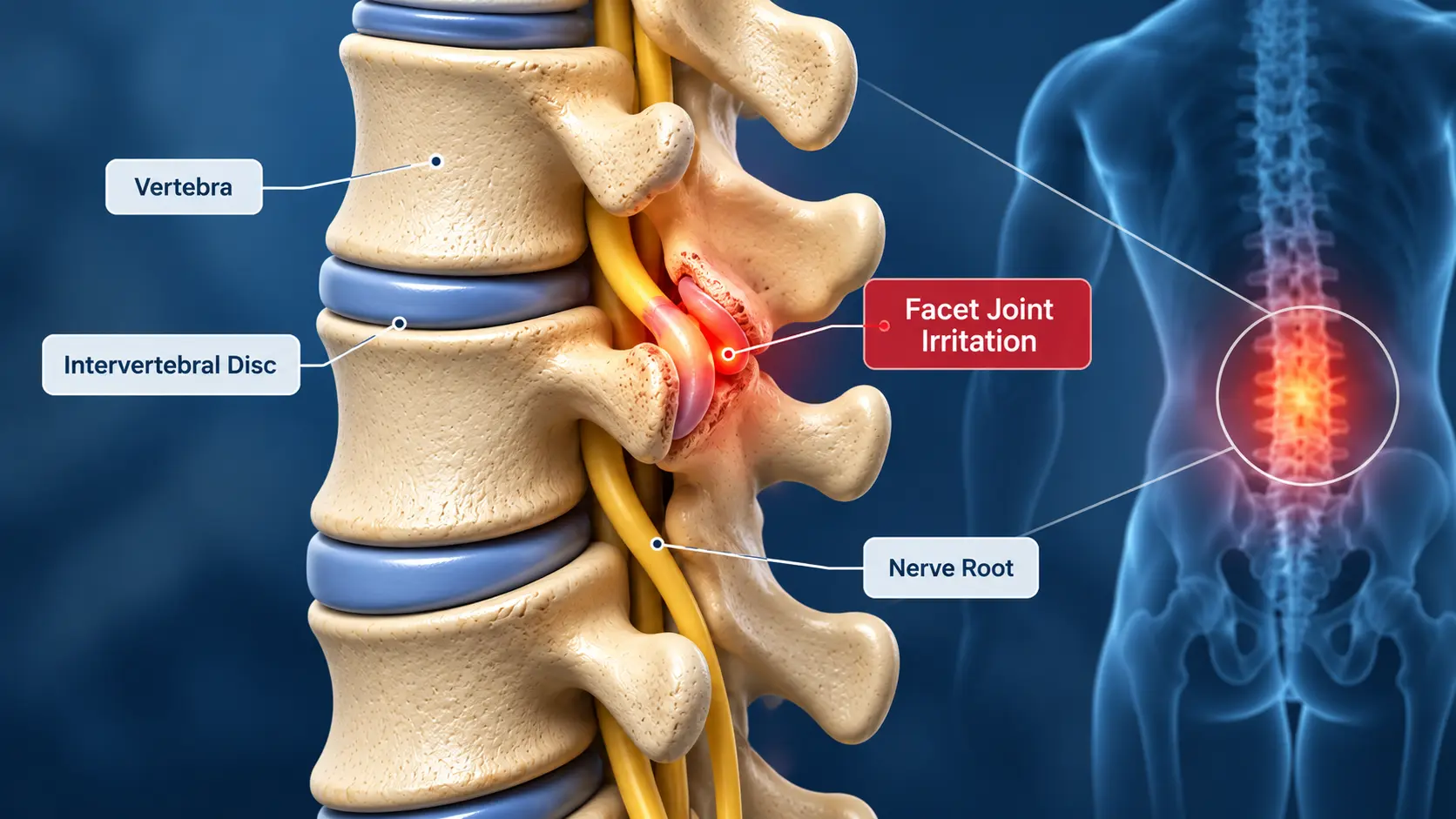
Your facet joints sit at the back of each vertebra, one pair at every level of your spine, and they are the small joints that let your back bend, twist, and extend. In the lower back specifically, these are called the lumbar facet joints, and they do a lot of quiet work every day, from reaching for something in a low cupboard to turning to check over your shoulder.
If you are trying to work out where are the facet joints in your back on your own, a rough guide is that they sit just to either side of the spine itself, not directly on the midline, which is part of why pressing gently on that area can sometimes reproduce the ache. Even so, pinpointing the exact joint is something best left to a proper examination, since several structures sit close together in that part of the spine.
Knowing roughly where they sit is useful context, but it is not the same as knowing which specific joint, at which level, is actually behind your pain. That level of precision matters once treatment is on the table, since a facet joint injection or a medial branch block needs to target the exact joint involved, not just the general area. Getting that precision is exactly what the assessment process further down this page is built to do.

Facet joint irritation symptoms usually start small, a stiff feeling after sitting too long, or a dull ache that comes and goes with certain movements. On their own, these are easy to brush off, and often rightly so, since a lot of minor back discomfort really does settle by itself within a week or two. A few signs, though, deserve closer attention rather than being waited out indefinitely:
None of these alone confirm a diagnosis, but together they are a reasonable prompt to get it looked at rather than guessed at. If two or more of these sound familiar, booking an assessment is a faster way to a real answer than waiting to see how the next flare behaves.
Facet joint inflammation causes are usually fairly ordinary, nothing dramatic, just wear and repeated strain building up over time. The most common ones include osteoarthritis wearing down the cartilage inside the joint, repeated twisting or extension from sport or manual work, a sudden awkward movement, and extra load on the joints after a disc loses some of its height. Most people we see have more than one of these overlapping at once, rather than a single clean cause, which is part of why the irritation can creep up gradually instead of announcing itself all at once.
Mentioning which of these sounds familiar, and roughly when it started, gives your clinician a useful head start before the examination even begins. It also helps separate a one-off strain from a pattern that has been building for months, which changes how the assessment is approached from the very first question.
It is tempting to match your symptoms against a list like the one above and call it settled. Lumbar facet joint irritation, though, shares a lot of its symptom pattern with other causes of lower back pain, including disc problems and simple muscle strain, which means symptom-matching alone can point you in the wrong direction.
Facet joint irritation lumbar spine changes, and facet joint irritation lower back pain more generally, can look almost identical to a muscular strain on the surface, both can ease with rest and flare with movement. The real difference is in the detail, which movements specifically bring it on, whether it responds to rest the way a strain usually does, and whether pressing directly over the joint reproduces it. Working that out reliably takes a proper examination, not a mental checklist.
A simple example: a pulled muscle in your lower back usually eases noticeably within a few days of rest and tends not to mind gentle, steady movement. Facet joint irritation often behaves the other way round, it can stay fairly constant regardless of rest, and specific movements like twisting or arching backward reliably bring it on, rather than movement in general making things worse. That kind of detail is easy to miss when you are simply trying to match your symptoms to a list, but it is exactly the sort of thing a proper assessment is built to pick up on.
If you have been going back and forth on whether this is worth a proper look, that uncertainty is itself the answer, the section below walks through exactly what an assessment with us involves, so you can decide with the full picture rather than half of it.
Booking a facet joint assessment process with us at RRMG starts with a simple enquiry, not a long wait or a referral chain.
Here is what the visit itself typically involves:
A medial branch block is a small, image-guided injection of local anaesthetic placed on the nerve supplying the joint. The NHS guidance on facet joint pain supports this same approach, confirming the joint as the source only once pain actually eases after the injection, rather than assuming it from symptoms or a scan alone.
Nothing about this process is designed to feel rushed. The point of combining a detailed conversation, a hands-on examination, and imaging where it is actually useful, rather than reaching for a scan as the first step, is to build an accurate picture before anything invasive is even discussed. Every case is personally reviewed, drawing on founder Dr Ralph Rogers’s years of image-guided musculoskeletal work, so the plan that comes out of your assessment reflects what was actually found in your specific spine, not a standard protocol applied to everyone with similar symptoms.
Once the picture is clear, you get a treatment plan built around what was actually found in your assessment, not a generic one handed to everyone who walks through the door with back pain.
A little preparation makes the first visit more productive. It helps to bring a rough note of when the pain started and what specifically seems to trigger it, since that detail often gets forgotten under the stress of an appointment. If you have had any previous scans, X-rays, or MRI reports, even from a different clinic, bringing copies along saves repeating imaging unnecessarily. A list of medications you are currently taking, and anything you have already tried for the pain, whether that is physiotherapy, painkillers, or simply resting it, also helps your clinician understand what has and has not worked so far, rather than starting from zero.
Facet joint irritation treatment options depend entirely on what the assessment actually confirms. For a mild, recent flare, activity changes and simple care are often enough on their own, easing off the specific movement that triggers it, staying generally active rather than resting completely, and giving it a few weeks before assuming anything more is needed. For irritation that keeps recurring or has been confirmed through a medial branch block, a facet joint injection or radiofrequency ablation are often the next steps, both available through our lower back spinal injections service. We cover how these specific procedures work, including the honest evidence picture on radiofrequency ablation, on our dedicated guide, Why Does Facet Joint Pain in Back Flare When You Twist, worth reading once treatment becomes the next conversation.
A minor flare, without much underlying joint wear, often settles within a couple of weeks once the trigger activity eases off. Irritation linked to ongoing wear tends to be less predictable, easing for a while and then returning with the same kinds of movement, rather than disappearing for good on its own.
Age, how physically demanding your week usually is, and how much wear is already present in the joint all play a part in which pattern you get. Two people with what sounds like the same irritation on paper can have very different timelines, which is another reason a generic answer online is less useful than a proper assessment of your specific joint.
Trying to push through the same triggering movements while waiting to see if it settles tends to stretch the timeline out further, rather than shortening it. If a flare is still dragging on past the few weeks you would normally expect, that is usually the point where an assessment, rather than another round of waiting, becomes the more useful next step.
Facet joint irritation recovery time after a facet joint injection is typically measured in days to a couple of weeks before the fuller benefit is felt, since the steroid takes a little time to settle the inflammation. Recovery after radiofrequency ablation is a bit different, relief usually builds over one to three weeks, and our lower back spinal injections page notes that benefit can last six to twelve months or more before the nerve regrows. Either way, recovery depends on what was actually treated, which is exactly why the assessment stage matters so much, treating the wrong thing never gives you a real recovery timeline to measure against.

We are a private regenerative orthopaedics and sports medicine clinic on Blythe Road in London, founded by Dr Ralph Rogers, and every patient who comes through our door is assessed and treated personally rather than handed between different clinicians. We work with a wide range of insurance providers, as well as self-funding patients, so getting a proper diagnosis does not have to wait for a long referral chain. Dr Rogers brings years of image-guided musculoskeletal experience to every assessment, which is part of why we lean on a confirmatory test rather than a best guess from a conversation or a scan alone.
If facet joint irritation keeps interrupting your week and you are not sure whether it needs seeing to, we can tell you plainly rather than leaving you to guess. You get a specialist assessment without a long NHS-style wait, no referral required, a confirmed diagnosis built on a real test rather than a best guess from a scan, a clear next step once we know what is actually going on, and the reassurance of Dr Ralph Rogers’s personal oversight on every case we take on. Because we confirm the source before recommending treatment, you also avoid paying for a procedure that was never going to fix the actual problem.
The longer facet joint irritation is left unassessed, the more it tends to settle into a pattern of flaring and easing rather than clearing up on its own, so there is a real advantage to getting it looked at sooner rather than later.
Booking is simple: fill out our request an appointment form with a short description of your symptoms, and our team will get back to you to arrange a time.
| Service | Indicative Price |
| Initial consultation | From £300 |
| Diagnostic medial branch block | From £2,000 |
| Facet joint injection | From £1,800 |
Visit our current fees page for exact, up to date pricing, since costs can vary by hospital location.
Get in touch
Sometimes, yes. A mild, recent flare without much underlying joint wear often settles within a couple of weeks with activity changes and simple care. Irritation linked to ongoing wear is less reliable though, it tends to ease and then return with the same triggers, rather than resolving completely by itself. If it keeps coming back, that pattern itself is a detail to mention at an assessment rather than treating every flare as a one-off.
Not necessarily, and a scan alone cannot actually confirm facet joint irritation either way. Imaging can show wear or changes in the joint, but plenty of people have those changes with no pain at all, and plenty of people with real facet joint pain have scans that look unremarkable. The only test that actually confirms the diagnosis is a medial branch block, which numbs the joint directly and checks whether that removes the pain.
A recurrence does not mean the original assessment or treatment failed, it usually means the underlying trigger, often a repeated movement or posture habit, is still present. Facet joint injections and radiofrequency ablation both calm the joint down rather than permanently changing it, so irritation can return if the same strain keeps happening. If it comes back, that is a good reason to get reassessed rather than assuming nothing can be done, since the next step might be different from the first.
Appointments are arranged directly with our team once you send through your enquiry, rather than sitting on a referral list. Because we are a private clinic, you avoid the typical NHS-style wait for a specialist assessment, and every case is personally handled under Dr Ralph Rogers’s direct involvement, rather than passed between different clinicians along the way. The exact timing depends on availability, so the most reliable way to find out how soon you can be seen is to contact our team directly with a short description of your symptoms.
Dr Rogers has had a rich and illustrious career so far, which is continuing to grow and develop. Everything Ralph has been involved in since qualifying has added value to his knowledge and experience, but there have been some impressive highlights to note:
2018 – Present Founder Medical Director: Rogers Regenerative Medical Group (RRMG)
2012 – 2024 Medical Advisor – National Basketball Association
2008 – 2018 Medical Director: The London Sports Injury Clinic London
2010-2011 First Team Doctor, Chelsea Football Club
2007- 2010 The Football Association (Team Physician for England under 19 and development squads)
2005-2006 Medical Advisor: Trinidad & Tobago World Cup Football Team
2002 – 2008 Club Doctor: Walsall Football Club, West Midlands England
1998 – 2009 Medical Director: Medical & Orthopaedic Sports Therapy,
2000 – 2005 Sports Physician: Warwickshire County Cricket Club, Birmingham