
Reading Time: mins

You did what you were told. You went to physio, you did the exercises, you may even have had a cortisone injection. And your joint still hurts. It is a frustrating place to be, and many people at this point start searching for what to do when physio doesn’t work, wondering whether this is simply how it is going to be, or whether surgery is the only thing left.
It usually is not the end of the road. Physio and steroid injections do help many people, but they do not work for everyone, and a lack of improvement is useful information rather than a failure on your part. In this guide we explain why standard care sometimes falls short, what to check first, the non-surgical options that may come next, and when a surgical opinion is the right move. This is general information, not a diagnosis, and it is no substitute for an individual assessment.
When physio and a steroid injection have not worked, the next step is usually to check the diagnosis rather than repeat the same treatment. A specialist assessment, often with ultrasound, can confirm the true pain source and show whether rehabilitation needs changing, or whether another non-surgical option or a surgical opinion is appropriate.
In practice, that means asking three questions in order. Is the diagnosis right? Was the treatment you had the right treatment, at the right dose, for long enough? And if so, what else is available before surgery? The sections below take each in turn.
There is rarely a single reason. In our experience, joint pain that is not improving after physio usually comes down to one or more of the following.
Pain is not always generated where you feel it. Hip problems can show up as knee pain, spinal and sacroiliac joint problems can be felt in the buttock and thigh, and neck problems can cause shoulder pain. If the treatment was aimed at the wrong structure, it is not surprising that it did not help, however diligently you followed it.
A tendon, a worn joint and a torn cartilage each respond to different types and amounts of loading. Rehabilitation that is too gentle may not challenge the tissue enough, while rehabilitation that is too aggressive can keep it irritated. Tendon problems often need months of progressive loading, which is longer than many people are able to keep going without seeing results.
A corticosteroid injection can calm inflammation and give a window of less pain. In osteoarthritis, NICE notes that the relief is typically short term, in the range of 2 to 10 weeks. If the injection was not guided by ultrasound, it is also harder to be sure the medication reached the intended spot. A steroid injection that did not help does not mean nothing can, and one that helped briefly tells us the joint or tendon is a pain source.
Long-standing tendon degeneration, cartilage loss or a worn joint can reach a point where exercise and anti-inflammatory treatment alone are not enough. This is not a reason for despair. It simply means the plan needs to move on, and your options depend on what the imaging and examination show.
Before adding another treatment, it is worth being sure what is being treated. A fresh assessment looks at your history again, including what has changed since the pain began, which movements set it off and what physio and the injection did or did not do. We then examine the joint and the areas around it, because the source of your pain may not be where the pain is felt.
Imaging can help, but it needs to be read in context. Many people have changes on an X-ray or MRI that are not causing their symptoms, and some painful joints look quite unremarkable. Ultrasound is useful because we can scan the joint or tendon in real time, look at fluid, tendon quality and inflammation, and press on the area while we watch to see what reproduces your pain.
Image-guided injection can also work as a test as well as a treatment. If a small amount of local anaesthetic placed precisely into a joint or around a tendon eases your pain, that supports it as the source. If it does not, we look elsewhere. Whether this is appropriate for you depends on your assessment, and we explain the reasoning before anything is done.
If you would like help working out where your pain is really coming from, you can read about our approach to non-surgical treatments.
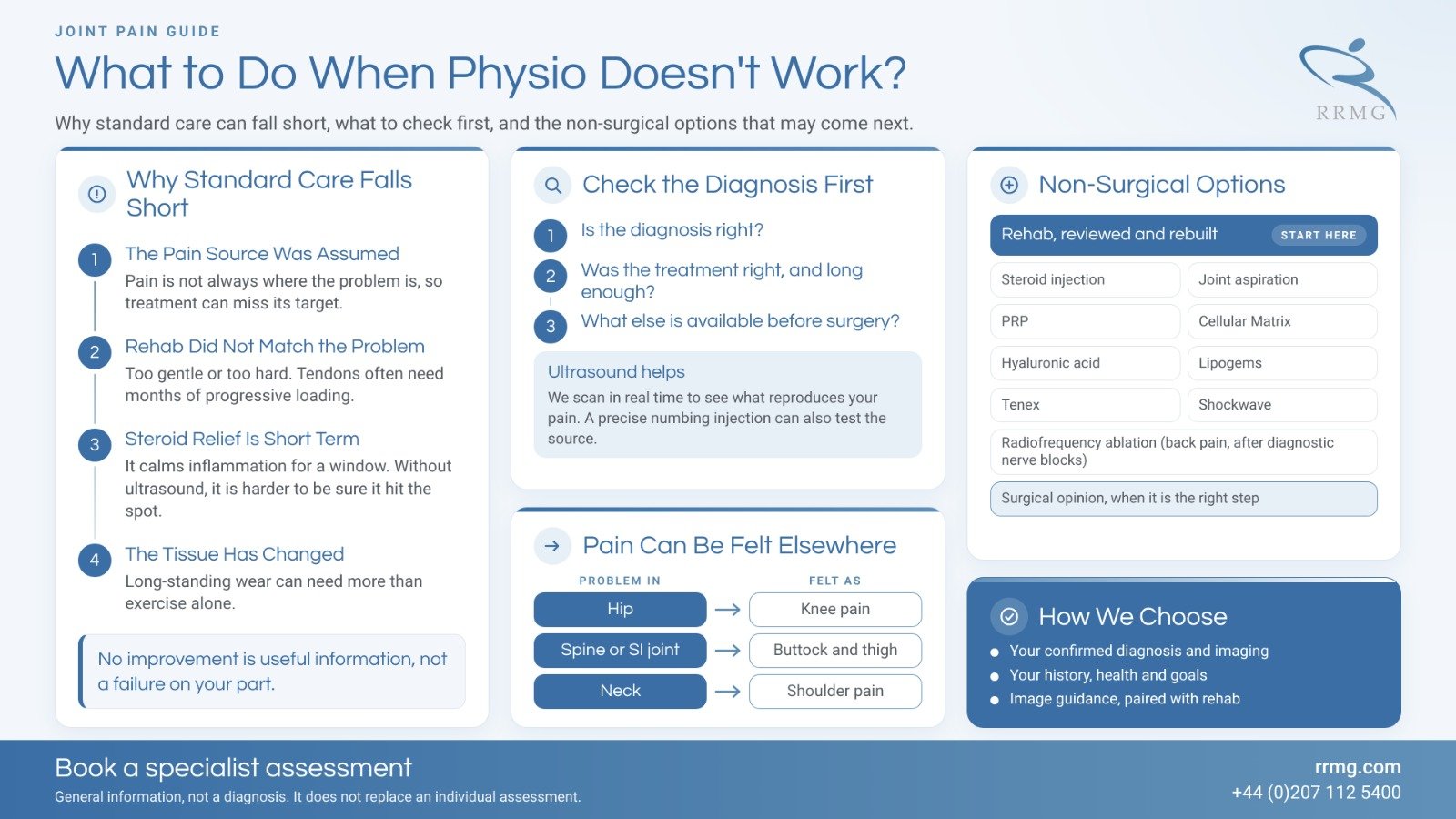
If the diagnosis is confirmed and standard care has not been enough, there are several options between more of the same and surgery. None of them works for everyone, and the right choice depends on the condition, how advanced it is, your health and what you want to get back to doing. We are open about what the evidence shows and where it is still developing.
Sometimes the most useful next step is not a new treatment but a better-targeted version of the old one. A structured programme that is matched to your diagnosis, progressed at the right pace and supported by exercise medicine and, where needed, bracing or activity changes can succeed where a generic programme did not. Most of the treatments below work best alongside rehabilitation, not instead of it.
Depending on your assessment, options we may discuss include:
These are not a menu to work through in order. Part of our role is to tell you honestly which, if any, are reasonable for you, and which are not. You can read more on our non-surgical treatments page.
We look at the confirmed diagnosis, how long you have had symptoms, the imaging findings, previous treatment, your medical history and your goals. A runner who wants to get back to training has different needs from someone who simply wants to climb stairs without pain. Where an injection is appropriate, we use image guidance, and every treatment is paired with a rehabilitation plan. We also tell you when we think a treatment is unlikely to help, and when a surgical opinion would serve you better.
The principles are the same in every joint, but the details differ. These are brief examples of how a stalled recovery can look in the three joints we see most often.
In the knee, ongoing pain after physio and a steroid injection is often osteoarthritis, a meniscus problem or a tendon problem, and sometimes pain referred from the hip. Swelling after activity is a clue that the joint lining is irritated, and ultrasound can show whether there is fluid worth draining. Our guide on why a knee swells after walking explains that pattern in more detail. Depending on the findings, options may include aspiration, image-guided injections or other regenerative treatments, alongside a rehabilitation plan.
The hip is deep, and pain often shows up in the groin, buttock or outer thigh, or is mistaken for a back problem. This is one reason a hip injection given without imaging can miss its target. Ultrasound or other image guidance helps place treatment accurately, and a careful examination helps separate hip joint pain from tendon, bursa and spinal causes.
Shoulder pain that persists often involves the rotator cuff tendons, the bursa or the joint itself, and sometimes the neck. Ultrasound shows the tendons and bursa well, which helps us distinguish a partial tear from tendinopathy or inflammation. That distinction matters, because the best next step differs, and some tears do need a surgical opinion.
If your problem is in one of these joints, our guides to knee pain, hip pain and shoulder pain go into more depth.

Non-surgical care helps many people, but we do not claim that surgery can always be avoided. A surgical opinion is worth seeking when imaging shows serious structural damage that rehabilitation and injections are unlikely to fix, such as a large rotator cuff tear, a locked or unstable knee, advanced arthritis that is severely limiting your life, or a joint that has stopped responding to everything else. Getting that opinion early is not a failure of non-surgical care. It simply means you decide with full information.
It is sensible to have your pain assessed if it has lasted more than a few weeks despite sensible treatment, keeps returning, limits your daily activities, sleep, work or sport, or has stopped improving after physio and an injection. Persistent pain that is not responding to care should be looked at again, not simply put up with.
If you have given physio and an injection a fair go and your pain is still affecting your life, a specialist assessment can save months of trial and error. At Rogers Regenerative Medical Group on Harley Street, London, we are led by Dr Ralph Rogers, Consultant in Regenerative Orthopaedics and Sports Medicine.
Our care pathway is simple. We begin with a consultation, where we review your history and previous treatment, examine you and use ultrasound where it helps. We then agree a plan built around you, which may include guided treatment where it is appropriate, followed by rehabilitation support. Your suitability for any treatment depends on an individual assessment, and there is no pressure to go ahead with anything.
You can read about the options we offer on our non-surgical treatments page, or see our fees for consultation costs.
First, have the diagnosis checked, because a treatment aimed at the wrong source will not help. A specialist assessment, often with ultrasound, can confirm the cause and guide whether to adjust rehabilitation, consider another non-surgical option or seek a surgical opinion.
It depends on the problem. Some conditions improve within weeks, while tendon problems often need several months of progressive loading. If you are not improving, or getting worse, it is reasonable to ask your physio to review the plan and to seek a second opinion.
No. A steroid injection treats inflammation, and if the cause of your pain is something else, or if the injection missed its target, it may have little effect. A different diagnosis or a different approach can still help.
They may help some patients, but they are not guaranteed and are not suitable for everyone. The evidence is still developing for some of them. We discuss what is suitable for you before any decision.
You have already done the right things and your pain is still there. The next step does not have to be more guesswork. A consultation with us gives you a clear answer on what is causing your pain, an honest view of the options, including when surgery is the sensible route, and a plan built around you. We work with a wide range of insurance providers, as well as self-funding patients.
Book a consultation at our Harley Street clinic and find out what to try next. Contact our team to arrange your appointment with Dr Ralph Rogers.
| Service | Indicative Price |
| Initial consultation | From £300 |
| Image-guided injection (one side) | From £600 |
| Aspiration under ultrasound | From £650 |
These are starting prices, and costs can vary by hospital location.
Get in touch
Dr Rogers has had a rich and illustrious career so far, which is continuing to grow and develop. Everything Ralph has been involved in since qualifying has added value to his knowledge and experience, but there have been some impressive highlights to note:
2018 – Present Founder Medical Director: Rogers Regenerative Medical Group (RRMG)
2012 – 2024 Medical Advisor – National Basketball Association
2008 – 2018 Medical Director: The London Sports Injury Clinic London
2010-2011 First Team Doctor, Chelsea Football Club
2007- 2010 The Football Association (Team Physician for England under 19 and development squads)
2005-2006 Medical Advisor: Trinidad & Tobago World Cup Football Team
2002 – 2008 Club Doctor: Walsall Football Club, West Midlands England
1998 – 2009 Medical Director: Medical & Orthopaedic Sports Therapy,
2000 – 2005 Sports Physician: Warwickshire County Cricket Club, Birmingham