
Reading Time: mins
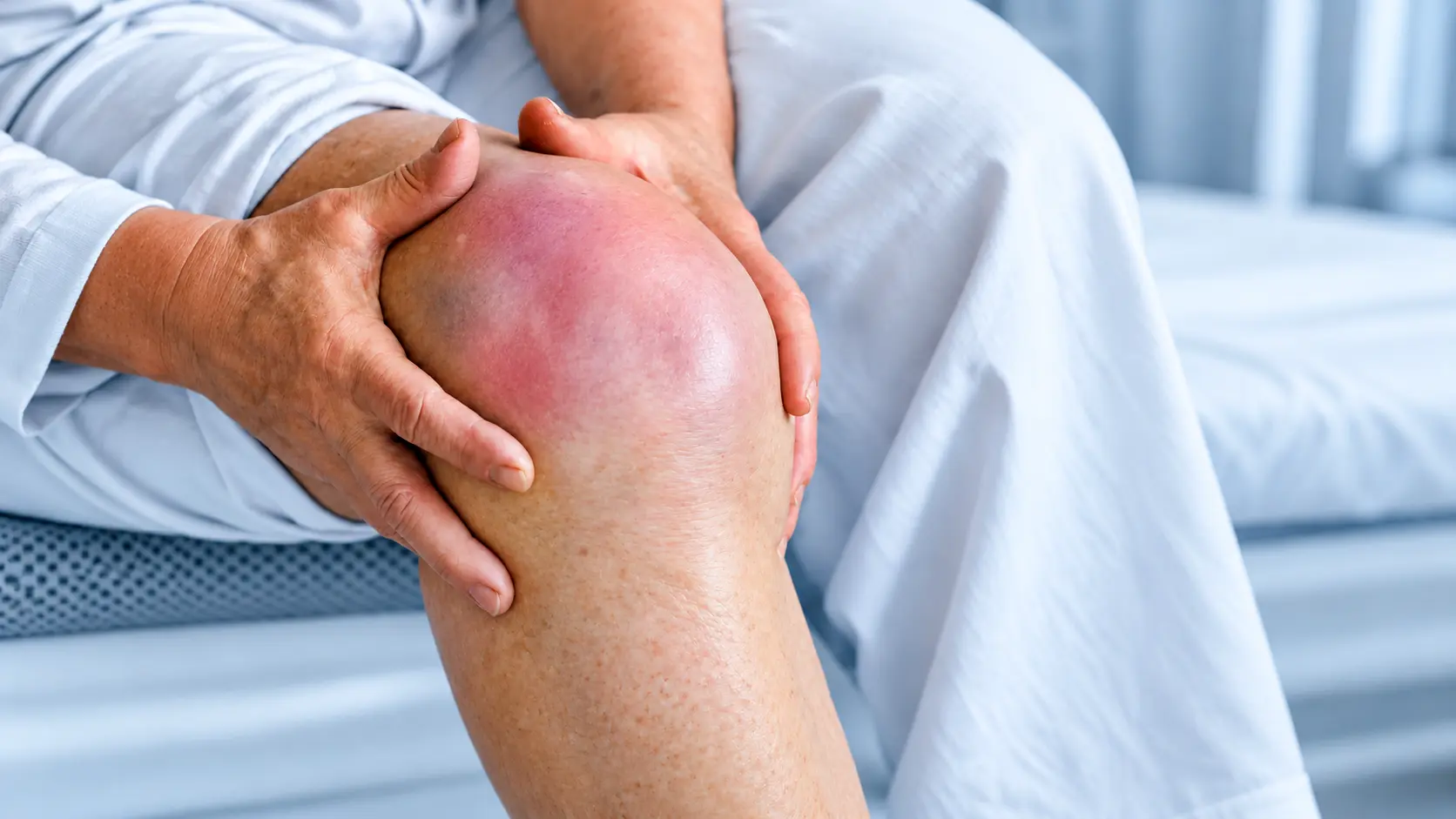
You go for a long walk, feel fine at the time, and by the evening your knee looks puffy and feels tight. There was no fall, no twist, no obvious injury. If that sounds familiar, you are probably asking why your knee swells after walking, and whether it means arthritis. In many people it does, but it is not the only possible explanation, and the swelling is one of the more treatable parts of the problem.
In this guide we explain what is happening inside the joint, how knee arthritis fits in, how we check for fluid, when swelling needs a doctor and what can be done about it. This is general information, not a diagnosis, and it is no substitute for an individual assessment.
Knee swelling after walking usually means extra fluid has built up inside the joint, often called an effusion or “water on the knee”. In knee osteoarthritis, an irritated joint lining makes more fluid when the joint is loaded. Injury, gout and inflammatory arthritis can cause it too, so persistent swelling is worth having assessed.
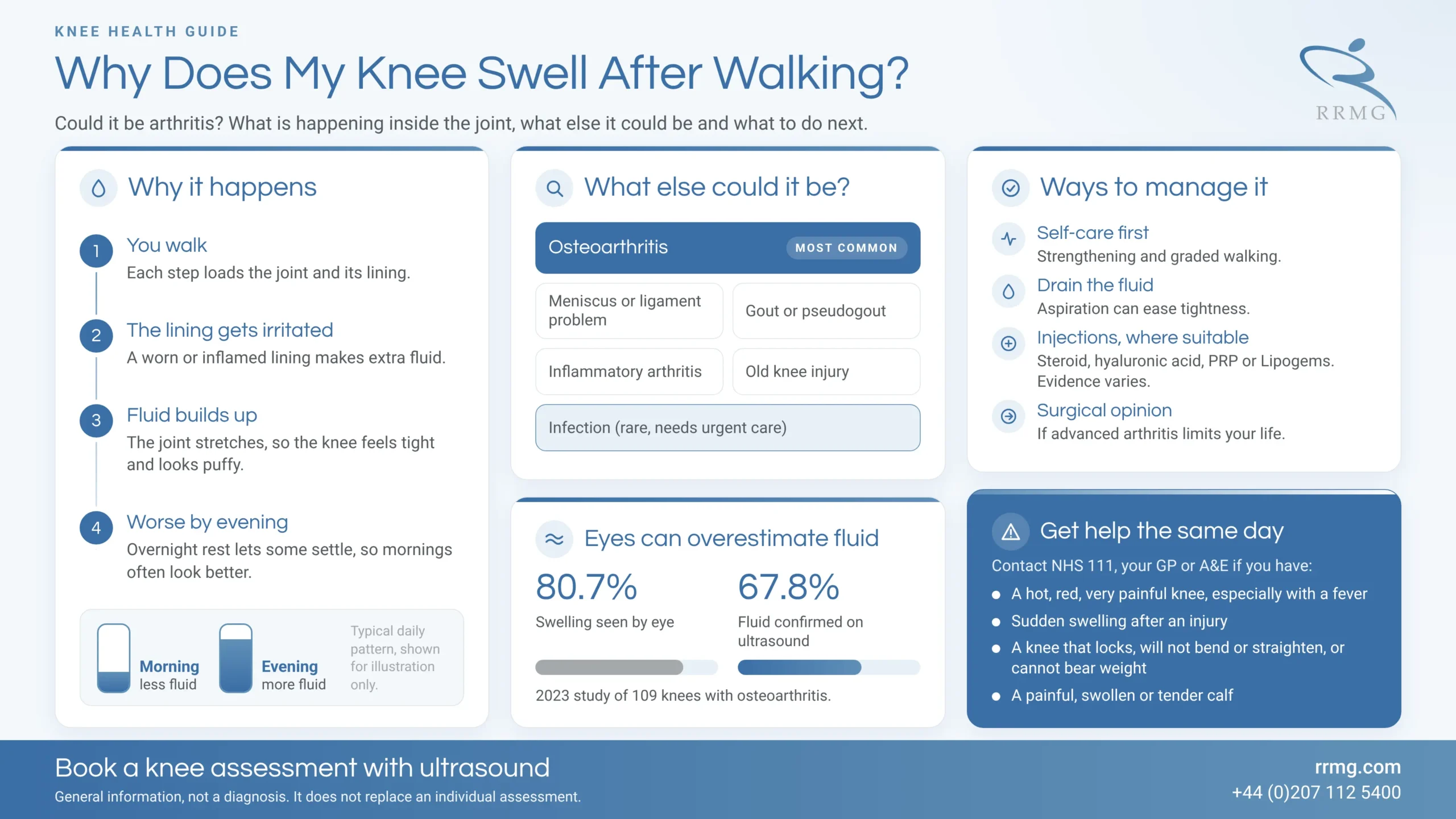
A healthy knee contains a small amount of slippery fluid that nourishes the cartilage and lets the joint glide. The lining of the joint, called the synovium, produces it. When the joint is worn or irritated, the synovium can become inflamed and produce more fluid than the joint can absorb. Walking, stairs and time on your feet increase the load, so the fluid often builds up through the day and is most noticeable in the evening. Overnight rest may let some of it settle, which is why many people notice the knee looks better in the morning and swollen again by the end of the day.
That pattern is typical of an irritated joint rather than a one-off injury, but it is not proof of arthritis. Other causes include a meniscus or ligament problem, gout, an inflammatory condition or, less commonly, infection. This is why we look at the pattern of your symptoms and, where appropriate, scan the joint rather than guess.
Knee arthritis is a group of conditions that cause pain, stiffness and sometimes swelling in the knee joint. The most common form is osteoarthritis, in which the smooth cartilage covering the bone ends gradually thins and the joint lining and surrounding tissues become irritated. It is a joint-wide condition, not simply “wear and tear” in the cartilage.
Knee osteoarthritis is common in the UK, especially after the age of 45, although it can start earlier after injury. It usually develops slowly, and symptoms often come and go. Many people with arthritic changes on a scan have little pain, and others with modest changes have a lot, which is why we treat the person and the symptoms rather than the X-ray alone.
Several types of arthritis can affect the knee, and the type matters because it changes the treatment:
Hot, red, rapidly swelling knees, or swelling with fever, need prompt medical attention rather than waiting to see how things settle.
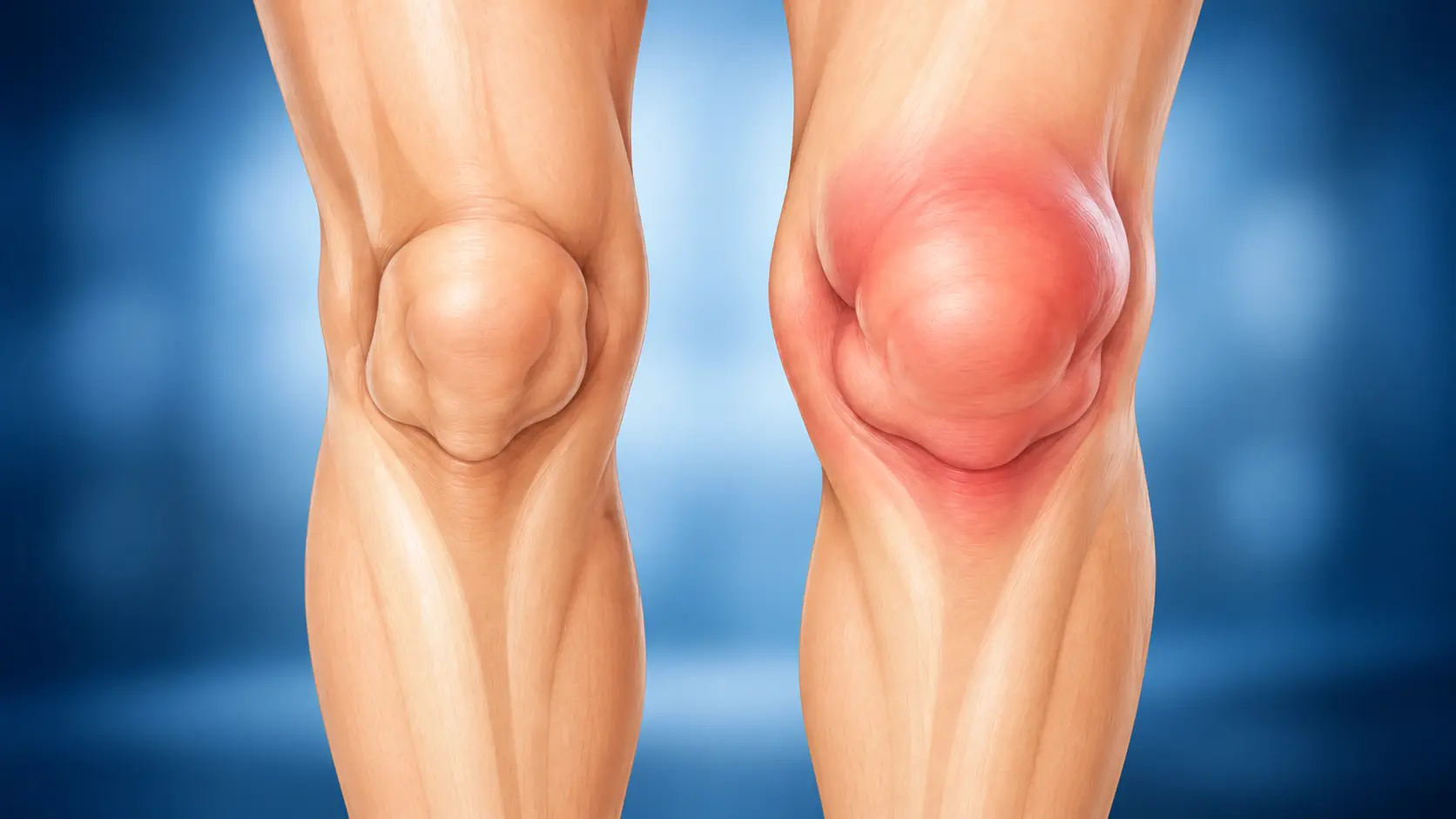
Swelling is only one part of the picture. Knee arthritis commonly causes:
Walking is good for a knee with arthritis in most cases, but each step loads a joint whose lining is already sensitive. As the extra fluid stretches the joint capsule, the knee feels tight and looks puffy, and bending it can become uncomfortable.
The amount of swelling does not always match the amount of pain. Some people have a visibly swollen knee with only mild aching. Others have a lot of pain with very little swelling. A big increase in your usual walking, a new job on your feet or a change of footwear can all tip an arthritic knee into a flare.
If you cannot recall an injury, arthritis is a leading cause, but not the only one. A degenerative meniscus tear can produce swelling after activity, as can a loose fragment of cartilage. Gout and other crystal conditions, inflammatory arthritis and, rarely, infection can all cause a swollen knee without any obvious trauma. A sudden, hot, red swelling is different from a slow build-up after walking, and should be seen urgently.
Some risk factors can be changed and some cannot. Knowing which apply to you helps explain why your knee may be reacting to everyday activity.
Having risk factors does not mean you will develop arthritis, and many people with several of them never do. Equally, arthritis can affect people with none. The practical point is that some of the factors, especially muscle strength, activity and weight, can be improved, and that can make a real difference to how the knee behaves.
We start by listening. When does the swelling appear, how long does it last, is it one knee or both, and has anything changed in your activity? We then examine the knee, looking at its shape, feeling for warmth and fluid, checking the range of movement and testing the ligaments and meniscus. We also look at how you stand and walk, because alignment and muscle control affect how the knee is loaded.
A knee can look swollen without containing much fluid, because the thickened joint lining and soft tissues can look and feel similar to an effusion. Ultrasound lets us see the difference in real time, in the room, without radiation. A 2023 study by Elsawy and colleagues in the Journal of Orthopaedic Surgery and Research looked at 109 knees in 80 people with knee osteoarthritis. Swelling was picked up by visual inspection in 80.7% of the knees, but ultrasound confirmed fluid in 67.8%.
In plain terms, judging by eye alone overestimated how often fluid was really present. That matters, because fluid, thickened lining and soft tissue swelling are not treated in the same way. Scanning also shows how much fluid is there and where it sits, which helps us decide whether draining it is worthwhile and how to do it safely.
If the picture is unclear, we may suggest an X-ray to see how much joint space is left and where bone changes are developing, or an MRI if we suspect a meniscus, ligament or cartilage problem. Where inflammatory arthritis, gout or infection is possible, blood tests or analysis of the joint fluid itself may be recommended. The aim is to find the cause of your swelling, not to collect scans for their own sake, and scan findings are always interpreted alongside how your knee actually behaves.
It is sensible to have your knee assessed if the swelling keeps coming back, lasts more than a couple of weeks, limits your walking, stairs or sleep, or has not improved with sensible self-care. Swelling that recurs after the same amount of walking is a pattern worth understanding, even if the pain is modest.
Some features need urgent attention the same day. Contact NHS 111, your GP urgently or go to A&E if you have:
If your knee is swollen but none of these apply, an early specialist assessment can often shorten the time you spend guessing. We can scan the joint on the day, confirm whether there is fluid and explain what it means for you.
There is no single best treatment for a swollen arthritic knee. The right plan depends on what is causing the swelling, how much it limits you, your medical history and what you want to be able to do. For most people the foundations come first, and injections or procedures are added where they make sense.
National guidance from NICE (NG226) puts exercise, support with weight management where relevant and, where appropriate, pain relief such as topical anti-inflammatory gels at the centre of osteoarthritis care. Strengthening the thigh and hip muscles takes load off the joint, and regular, graded walking is usually helpful rather than harmful. If swelling follows a long walk, building up in smaller steps, using supportive footwear and resting with the leg up for a short time afterwards can help settle a flare.
When the knee is tight and swollen with fluid, aspiration can be considered. This means using a fine needle, guided by ultrasound, to draw the excess fluid out of the joint. Taking pressure off the joint can ease tightness and make it easier to bend and move, and the fluid can be sent for analysis if there is any doubt about its cause. Fluid can return if the underlying irritation continues, so aspiration is usually part of a wider plan rather than a stand-alone fix. You can read more about the procedure on our joint aspiration page.
In the Elsawy study, aspiration was successful in 77% of knees overall, and success depended in part on the needle used. That is one reason we use ultrasound to see the fluid and guide the needle rather than relying on feel alone.
If swelling and pain are limiting you despite the basics, injections can be considered. We choose between them carefully, and we are open about what the evidence does and does not show:
Our fees page sets out the cost of consultations and procedures.
Non-surgical care helps many people, but not everyone, and we do not claim that surgery can always be avoided. If your knee has advanced arthritis, is seriously limiting your life and has not responded to other treatment, referral to a knee surgeon to discuss options such as knee replacement may be the right next step. An honest assessment of that is part of what a specialist consultation should give you.

If your knee swells after walking more than once or twice, or the swelling is limiting what you do, a specialist assessment can give you a clear answer instead of weeks of wondering. At Rogers Regenerative Medical Group on Harley Street, London, we are led by Dr Ralph Rogers, Consultant in Regenerative Orthopaedics and Sports Medicine.
Our care pathway is simple. We begin with a consultation, where we listen to your history and examine the knee, using ultrasound to check for fluid where it is helpful. We then agree a plan built around you, which may include guided treatment such as aspiration or an injection where it is appropriate, followed by rehabilitation support to help you stay active. There is no pressure to proceed with any procedure, and your suitability for any treatment depends on an individual assessment.
You can read more about draining a swollen knee on our joint aspiration page, or see our fees for consultation costs.
Book a knee assessment with ultrasound and find out what is behind the swelling.
No. Arthritis is a common cause, but a meniscus problem, gout, inflammatory arthritis or an old injury can also cause it. The pattern of your symptoms, an examination and sometimes a scan help tell them apart.
For most people with knee arthritis, regular walking is beneficial. If the knee swells, try shorter, more frequent walks, build up gradually and rest with the leg raised afterwards. If swelling is increasing, or comes with heat, redness or fever, get it checked.
Often it is not dangerous, but it should not be ignored if it keeps returning. A hot, red, very painful knee, swelling with fever, or a swollen painful calf needs urgent medical attention.
Yes. Fluid can be drawn out with a needle, a procedure called aspiration, and ultrasound helps guide it. Draining can ease tightness and allow the fluid to be tested if needed. Whether it is right for you depends on your assessment.
It can, especially if the joint stays irritated. That is why aspiration is usually combined with a plan for the underlying cause, such as strengthening, activity changes or other treatment.
If your knee keeps swelling after walking, you do not have to keep guessing or planning your life around it. A consultation with us gives you a clear picture of what is happening inside the joint and a plan built around you, not a generic one.
At your appointment, we listen to your history, examine your knee and, where it helps, scan it with ultrasound to check for fluid. We explain what we find in plain language and set out the options that suit you, including their benefits and their limitations. If aspiration or an injection could help, we tell you whether it is appropriate and how it would be done. There is no pressure to proceed with anything, and you stay in control of every decision.
Book a knee assessment with ultrasound at our Harley Street clinic and find out what is behind your swelling. Contact our team to arrange your appointment with Dr Ralph Rogers.
Dr Rogers has had a rich and illustrious career so far, which is continuing to grow and develop. Everything Ralph has been involved in since qualifying has added value to his knowledge and experience, but there have been some impressive highlights to note:
2018 – Present Founder Medical Director: Rogers Regenerative Medical Group (RRMG)
2012 – 2024 Medical Advisor – National Basketball Association
2008 – 2018 Medical Director: The London Sports Injury Clinic London
2010-2011 First Team Doctor, Chelsea Football Club
2007- 2010 The Football Association (Team Physician for England under 19 and development squads)
2005-2006 Medical Advisor: Trinidad & Tobago World Cup Football Team
2002 – 2008 Club Doctor: Walsall Football Club, West Midlands England
1998 – 2009 Medical Director: Medical & Orthopaedic Sports Therapy,
2000 – 2005 Sports Physician: Warwickshire County Cricket Club, Birmingham